Giving Myself Grace

In 2015, I self-published my first children’s book. This was a fulfillment of a dream that began in my tweens. Holding a physical print-on-demand copy of that book was validating. Fast forward a few years later, when my Megaton Kid prequel issue was released in Big Bang Adventures #5, and I was thrilled. There has always been something very satisfying to see my stories produced in tangible ways. Each new completed project came with a sense of accomplishment, and I’ve been grateful for every opportunity I’ve had to see that happen.

In September 2024, I funded my first Kickstarter to launch the Red Cat miniseries. This was my first comic book that was all mine, my story and my art. I was excited to have it done, and looking forward to getting the next one out soon after. 


Yet, it soon became evident that it wasn’t going to be easy. Current events have been far more distracting and concerning than usual, and that’s saying a lot. As weeks turned into months and then over a year, and I was still trying to get everything ready for the issue two launch, I began to doubt myself. Then it occurred to me that I needed to give myself a little grace.

I know that stories have value, and I want to be part of something valuable. I’m going to keep pushing forward on the next installment. I’m also going to get my first novel published this year. I’m also going to recognize that it might not be as quick as I wanted it or planned it to be. That’s okay. I may have lost momentum, but it’s never too late to regain it.


A friend I hadn’t seen in a while asked me how I find time to work on my side projects. Truth is, I don’t always, but I always try to. It’s never been about arriving. It’s always been about going.


So stick around if you like, and journey with me. I only have a loose plan for where I’ll end up. I hope I’ll have a blast getting there. I promise it will be something to see.
Looking for Meaning

I cannot in good conscience continue forward with Red Cat without considering its value. There is nothing typical about the last year. Too much has happened, and remaining silent risks complicity. I’m telling stories to bring hope, laughter, and fun to a small, but growing fan base, because entertainment has always had value in troubling times.

Still, to write stories about heroes is to write stories about people who face the darkness and do not succumb to it. These stories challenge me to recognize that in the comics, the good guys wear masks, but in the real world, we cannot hide behind them.

I am not a subject matter expert on politics, on religion, or on the economy. So I question if my opinion is valuable when so uninformed. I’m trying to keep up, to learn, to grow, to have rigid roots and flexible branches. I need to stand by my principles, to say this is not the America I was raised to believe in, and that I need to make it clear that I will not sacrifice principles for the sake of sales. 


I appreciate having fans and supporters from all walks of life. However, Red Cat lives by what I stand for, that America is a place where the only people who have no place here are those who make no room for anyone they don’t align with. There’s room for everyone in this world, if everyone makes some room. The single most important phrase in the most famous verse in the Bible is “loved the world”. When we forget that, we’ve already lost.

Ecclesia!

The Struggle is Reality

Growing up, I had a number of challenges to navigate. I was a skinny kid. My family moved at an alarming pace, as my dad spent years going from job to job and industry to industry. I was picked on a lot. All the while, I read voraciously and maintained a vivid imagination. 

From an early age, I questioned things, though not always successfully. As a kid, I couldn’t explain to my parents that when I said I could eat pizza for every meal, I did not mean the same pizza. I saw the bigger picture, that pizza was full of so much greater diversity than frozen cheese. 

After my conversion experience at thirteen, my inquisitive nature was somehow in opposition to my newfound religious practices. My teen years were spent being told to adopt blind, childlike faith, to “do all things without murmuring and arguing” (Philippians 2:14), to not be a Doubting Thomas, that if I had enough faith, I wouldn’t need to question. Just trust and obey, and it would all be okay.

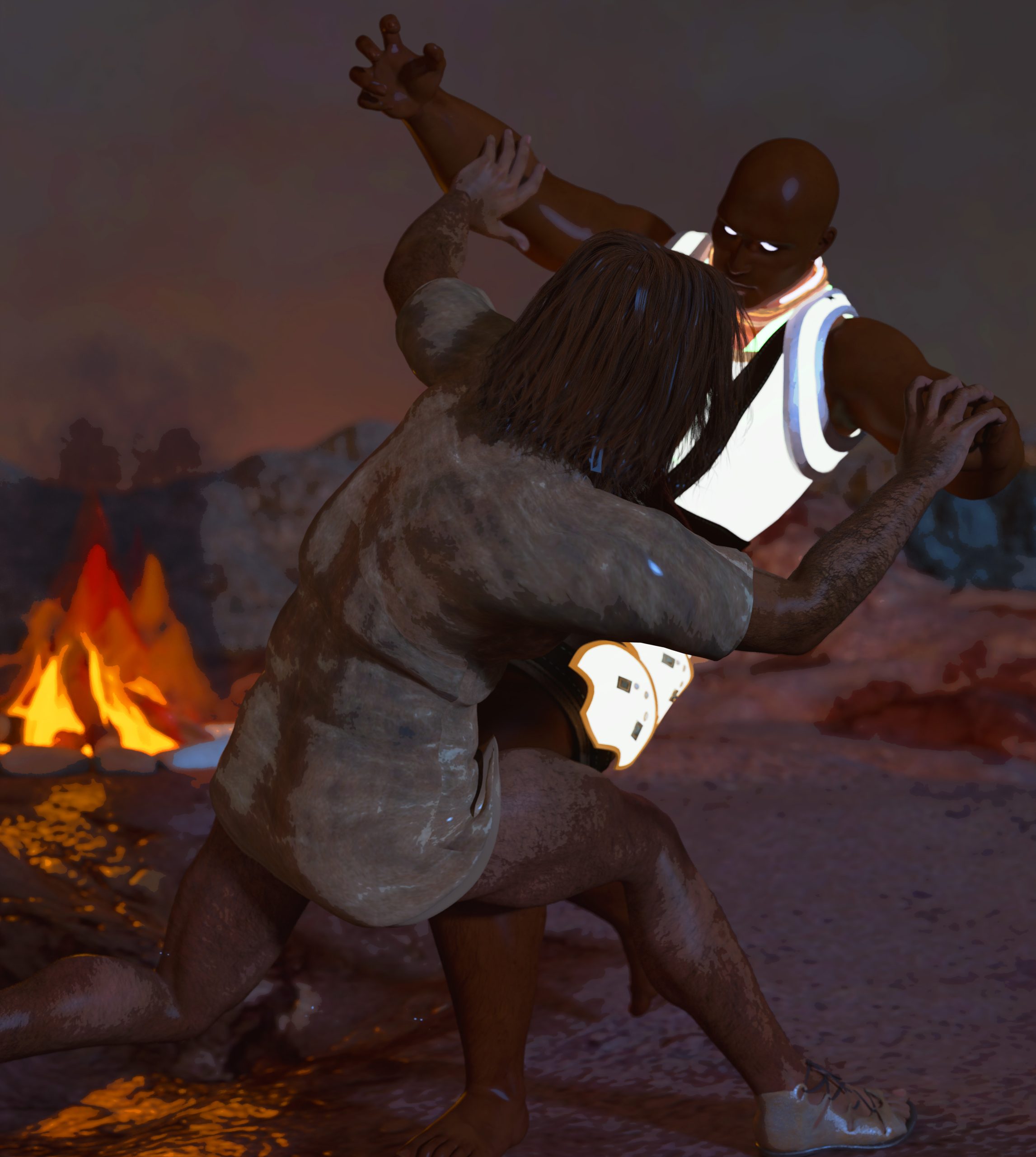
But what about Jacob? Jacob who wrestled with God. Who probably thought at first he was defending his people from a vengeful Esau, but only towards the end realized he was fighting a different person altogether. Whose name was literally changed to “struggles with God” (Israel). Then there was Moses, who pushed back on God’s plan repeatedly, and God met each objection with reassurance and help, such as sending Aaron to him. Habakkuk argued with God. Rather than rebuke him, God entered the dialogue and showed him a bigger picture. Even Jesus, in Gethsemane, asked to be spared from the inevitable. Faith is not the absence of struggle; faith is the willingness to bring that struggle to God.

Children can often take things at face value. Adults learn to question because questioning leads to deeper understanding. As I prepared this week’s journal entry, I came across this essay from Reverend Benjamin Cremer that builds on this idea of questioning in a profound way. Feel free to check it out.

https://www.facebook.com/share/1ARyyvHaHh/?mibextid=wwXIfr

Ecclesia!

A Mirror Universe

My conversion experience gave me a lot to think about and a lot to question over the years. The concept of a divine Creator who said in Genesis 1:26a, “Let us make humans in our image, according to our likeness…” made me wonder how that worked. Obviously I can’t speak Creation into existence. Obviously I’m not immortal, and infinite, and all-powerful. So how do I reflect God? How do I visualize reflecting God in an accurate way? 

Consider the mirror. When I look at a mirror, everything I see looks real. It looks alive, it has depth, it reflects me in every way save one. It’s two dimensional. Everything I see is limited to the plane of the substrate behind the glass. I see God, then, as fourth dimensional compared to us. With one less dimension I can still be a limited yet clear and accurate reflection of God. 

So when God creates a universe (or perhaps a multiverse) with only words, I can replicate that. I can create worlds with words, with lines on a page, though with one less dimension than I possess. I can do all the things God would to create Red Cat, or any other character, except make them living, breathing souls. And when I do, when I express myself creatively to create something out of nothing, I believe I’m truly reflecting God. 

That didn’t always reflect the church around me. It sometimes felt like only certain types of creativity and reflection were allowed. Creating fiction had its limits, because it had to be grounded in a perception of truth and reality as presented in the Bible. I often wonder if the people in those churches trying to discourage me from creating science fiction, or superheroes, or aliens, or what have you, believed that when Jesus told a parable, the story actually happened. Maybe Atlantis was actually on a mountain until someone with mustard seed faith threw the whole thing into the ocean.

The point is, everything story I tell is in some way a reflection of me, of how I think, feel, and believe. I believe that makes it the most honest thing I do, and in a way, the most spiritual as well. Ecclesia!

There’s Magic in the Air

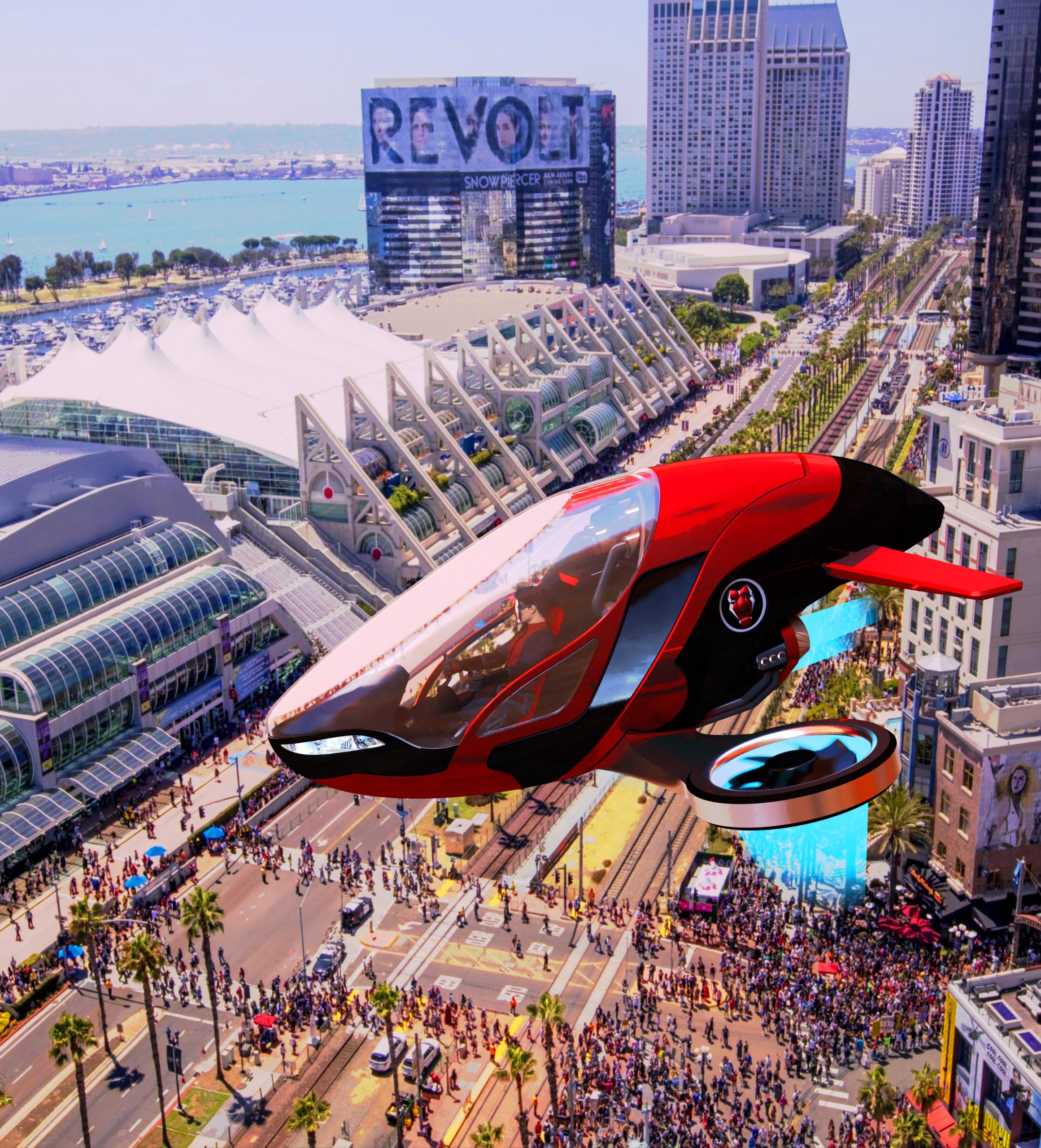
Imagine for a moment arriving at San Diego Comic-Con in a flying car to promote a comic book. The whoosh of the wind, the noise of the turbines, the inevitable shouts of “Look! Up in the sky!”


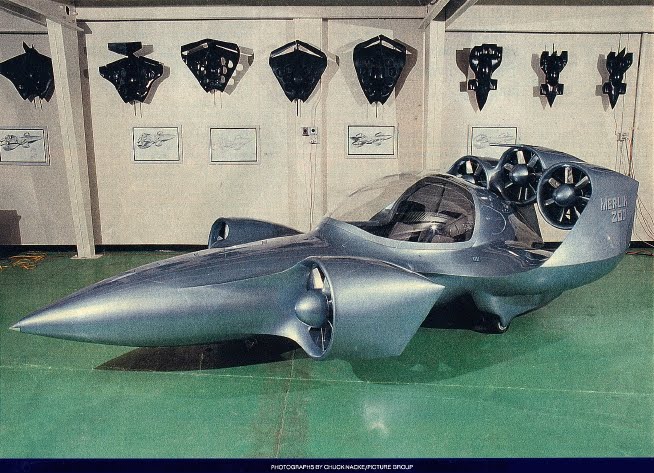
As a teen, I became infatuated with concept cars and hot rods. Anything vehicular and unusual was fascinating to me. My parents, in an effort to support my interests, bought me one of those subscriptions that were the predecessors to today’s monthly subscription boxes. Every month, a new pack of letter-sized inserts arrived for my Wheels and Wings 3-ring binder. One pack came with a sheet dedicated to a flying car called “the Moller Merlin”. At that time, the prototype looked like a cross between the Mach 5 from Speed Racer and a submarine.

Fast forward to the late 90s. My best friend and I were deep into our pining/planning to launch our shared comic book universe. This was prime Web 1.0 time, and I was just beginning my graphic design career. We had no idea how to fund such a project, but I began to do some research into investing. Along came a friend from church with big ambitions of his own. He convinced us that not only did we need a business plan, but that we needed to go big and swing for the fences. What started as a small goal to raise maybe $10-15k ballooned into a sixty-page business plan looking for about $4.5… million!

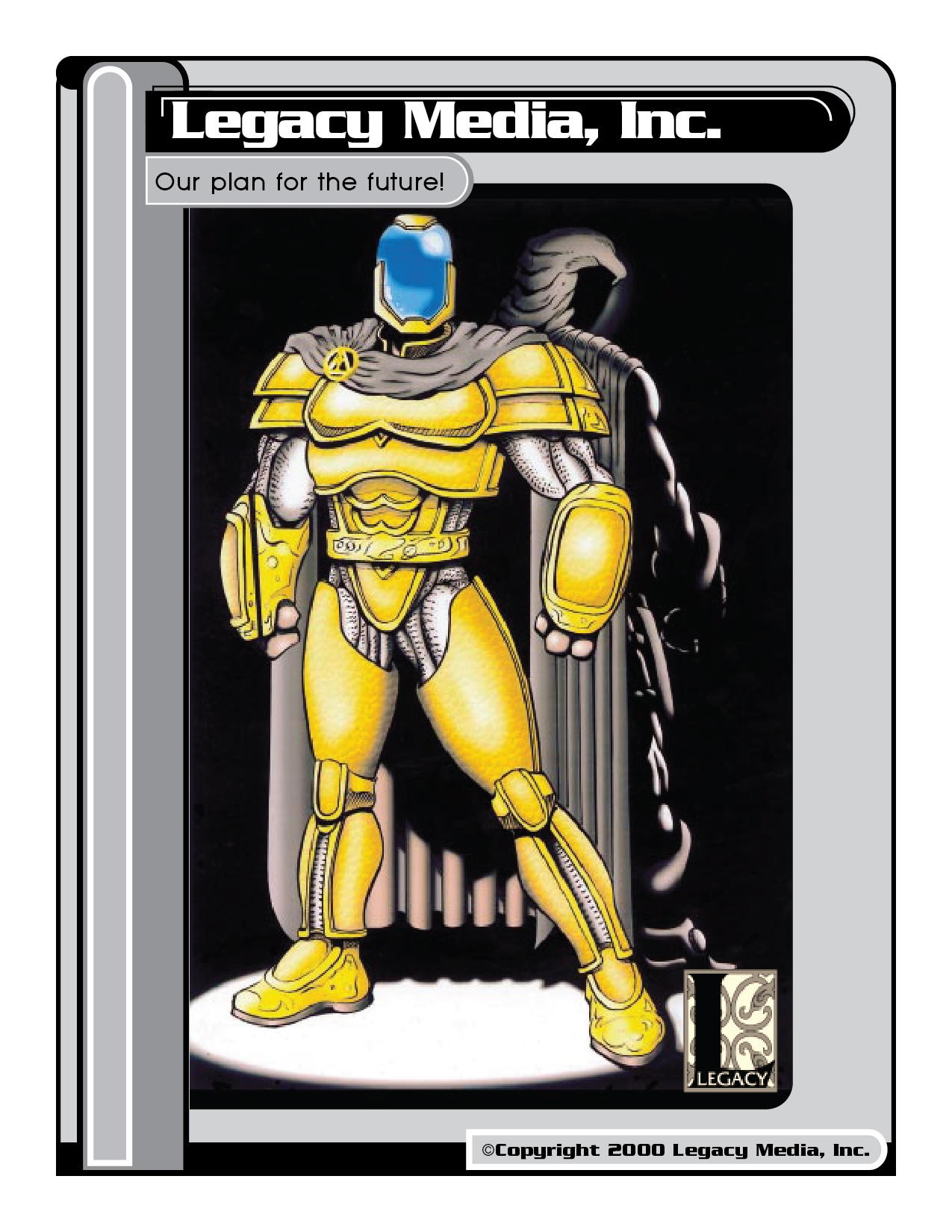
Included in there was the thing I still get teased about to this day. We imagined a scenario just like the one at the top. A Legacy-branded (more on that later) flying car that we could use to soar around the country, visiting conventions to promote our soaring dreams of remaking the comic book landscape and challenging the big three. 

On the one hand, I deserve the mockery. On the other, I never lost the underlying dream of independent publishing. So while I’m tooling around in a much more modest, grounded vehicle, I still have soaring dreams of independence to tell my stories the way I want to tell them. Because, like Avery Brooks suggested back in 2000, we don’t need flying cars when we can connect to people everywhere via the internet. 

Vagabond Creative Entertainment has only started crawling these days, but I’ll never give up trying to fly. Ecclesia!

Playing the Role/Roll

Role-playing games. They’ve been around for decades, starting with Dungeons & Dragons in 1974. So they’re almost as old as Southwest Airlines. (Random trivia is my love language.) My first introduction to D&D happened around 1980. My mom became close to a single mom of one boy five years my senior, and our families lived together for a time. He set me up on my first dungeon crawl with my party of adventurers. They were trying to find and defeat a powerful magic-wielding sheik who ruled the nearby city. I had no idea what I was doing, and I loved every minute of it… right up until I discovered it was a suicide mission all along. After an epic and costly battle, my last party member defeated the sheik, only to die at the hands of the newly freed citizens when he emerged. In a Twilight Zone-esque twist my character didn’t speak their language and couldn’t explain he wasn’t with the villain. It was all a bit jarring at that age.

In 1984, after my family’s conversion experience, my parents bought into the Satanic Panic. TTRPGs, comic books, He-Man, and lots of other things were a gateway for demonic activity so it all had to go. They wouldn’t even let me read “Lord of the Flies” in high school (not that I’m complaining. It’s kind of a downer.)

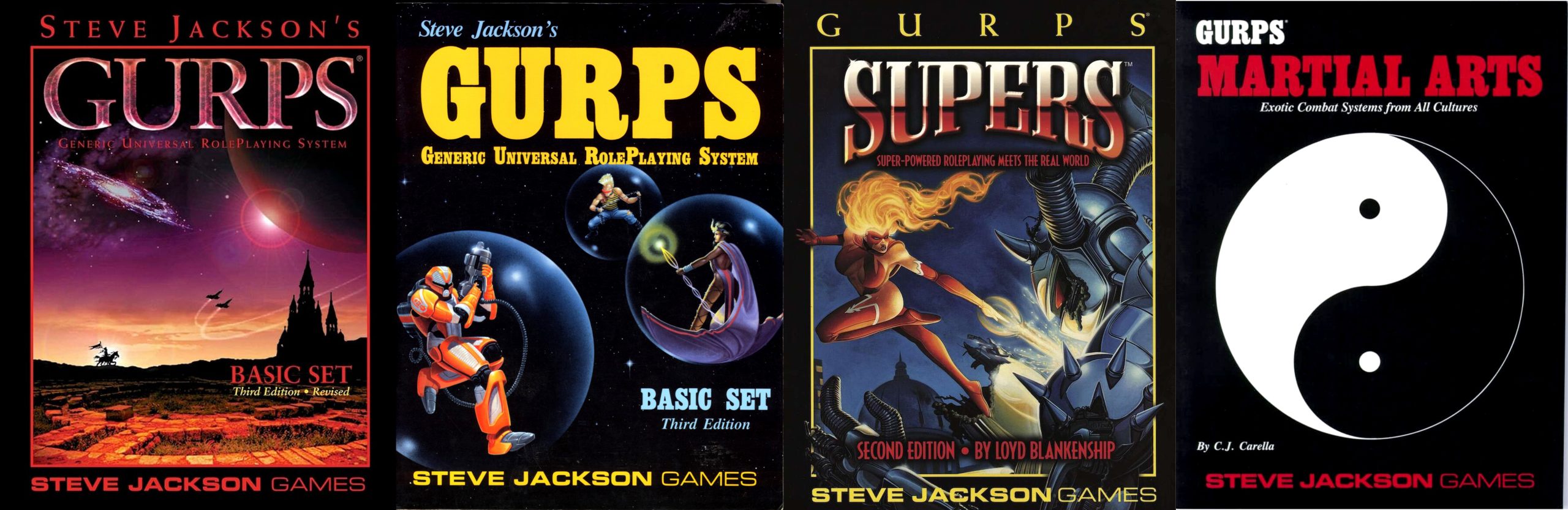
Fast forward to 1990, when I met North Roberts. He’s a full-on actor now but back then his storytelling skills were already impressive. I was very interested in developing my stories, and North introduced me to the idea of using TTRPGs for plot and character development. I was still worried about the fantasy and “evil” of D&D, but he showed me another way. There was a very generic, very universal RPG that could be made into anything. It gave you the rules and let you build your worlds how you wanted. GURPS allowed us to craft and control all the details of our characters, and use the framework of the game mechanics and rules to test out story ideas and work out personalities by playing “in-character”. It was game nights and acting classes at the same time. Feel free to roll your eyes when I tell you my first major player character was female. In my defense, I was young.

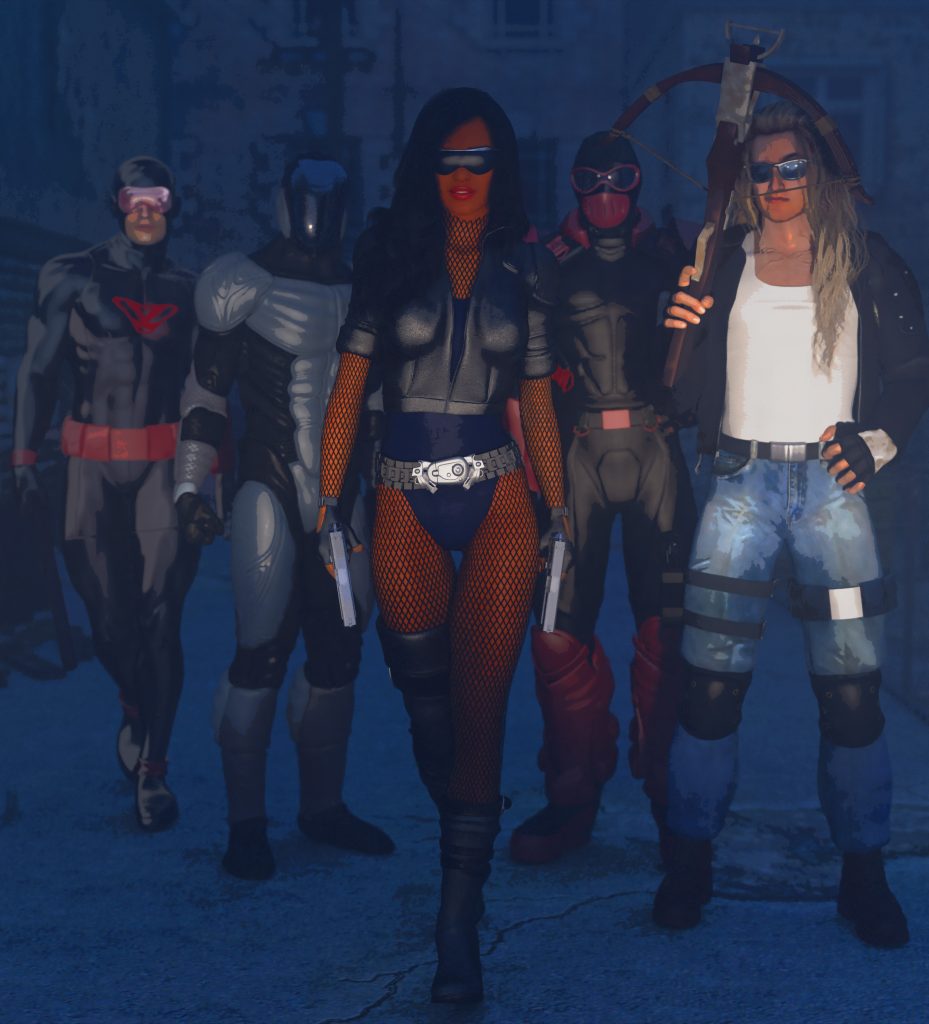
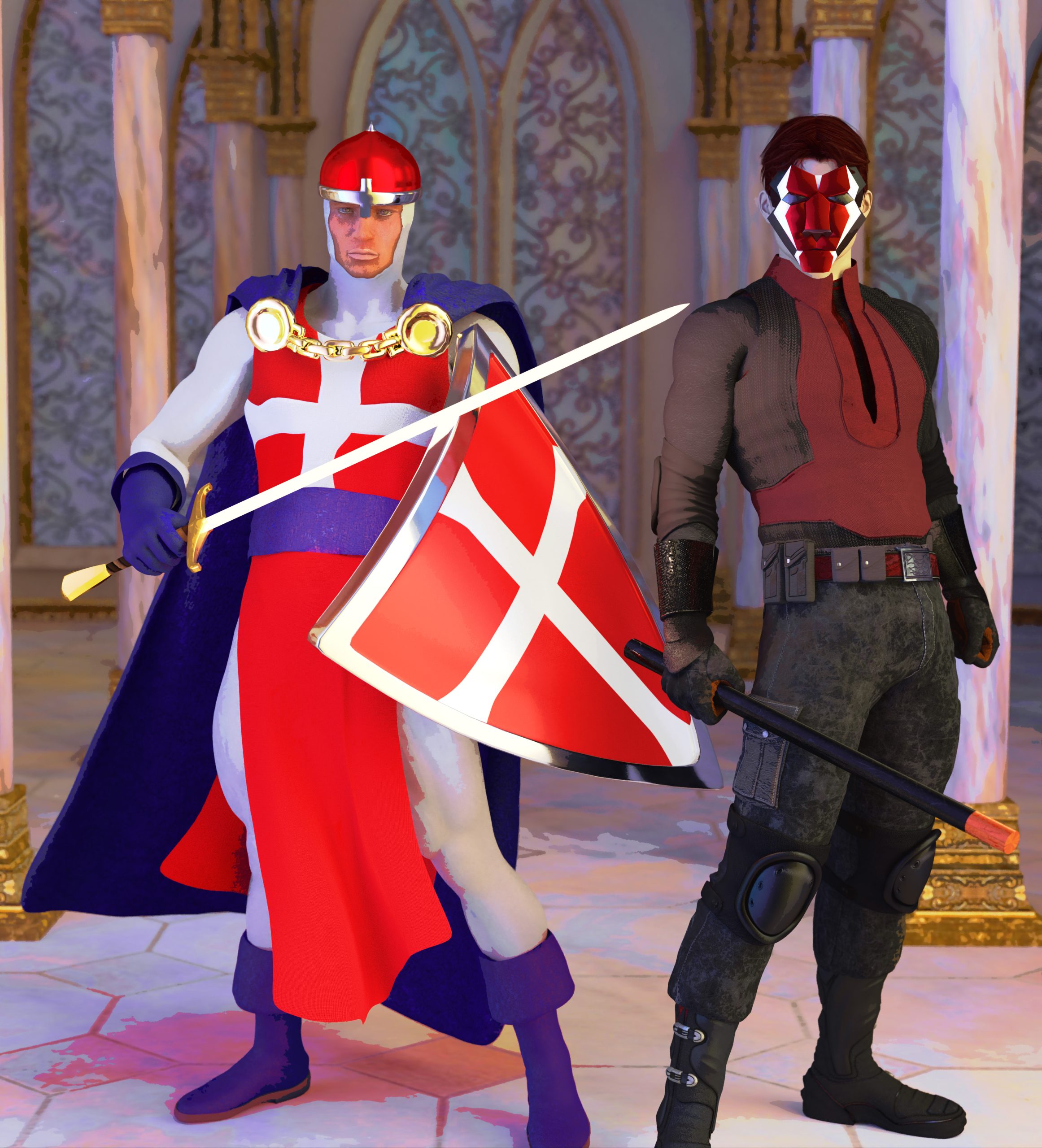
From left to right: Knightstrike, aka Stryker Knight, who would evolve into Red Cat, Black Rain, Cold Steele, Nightfire, and Crossbow, who was named after GURPS founder Steve Jackson. Characters are placed from front to back in the order of their in-game creation over the years. Special credit and thanks to Brett and Cam for their contributions and permission.

For the next three or four years, I played GURPS exclusively. Most of that time was spent developing the stories, characters, and ideas that laid the foundation for the Vagabond Universe. Red Cat was one of the later heroes I created. Eventually, I would meet other players and learn to play other game systems, exploring multiple genres and even running games as a DM/GM. I never forgot those early game sessions, some all night, at the local Olympic Star, a 24-hour Greek-owned family restaurant that still operates in Tinley Park, IL. Whether it was the relationships and personalities molded through hours of pretending to be someone else or the way the dice created a chaos factor that always kept things dynamic, I doubt I would be the writer I am today if I hadn’t opened myself up to the idea that playing pretend is a great way to stay real. Ecclesia!

Crusader of what?

From a very young age I loved comic books. The brightly colored images and the dynamic action kept me glued to the page. For a long time I was only able to read a few here and there because it wasn’t a hobby I shared with my parents. Then things changed in 1984, when I began my lifelong faith journey through a conversion experience on, of all days, Halloween.

My family went the Pentecostal route at the beginning. The late 80’s was like the cultural golden age for those kinds of churches. The music scene was thriving, and Christians were going mainstream whenever possible. Moving into my teen years gave me more financial freedom, but the dearth of Christian comic books left me with few options to explore. It was hard to imagine a Christian superhero existing in mainstream comics, because my parents were convinced that anything that wasn’t in the Bible was fiction, and fiction was the antithesis of truth.

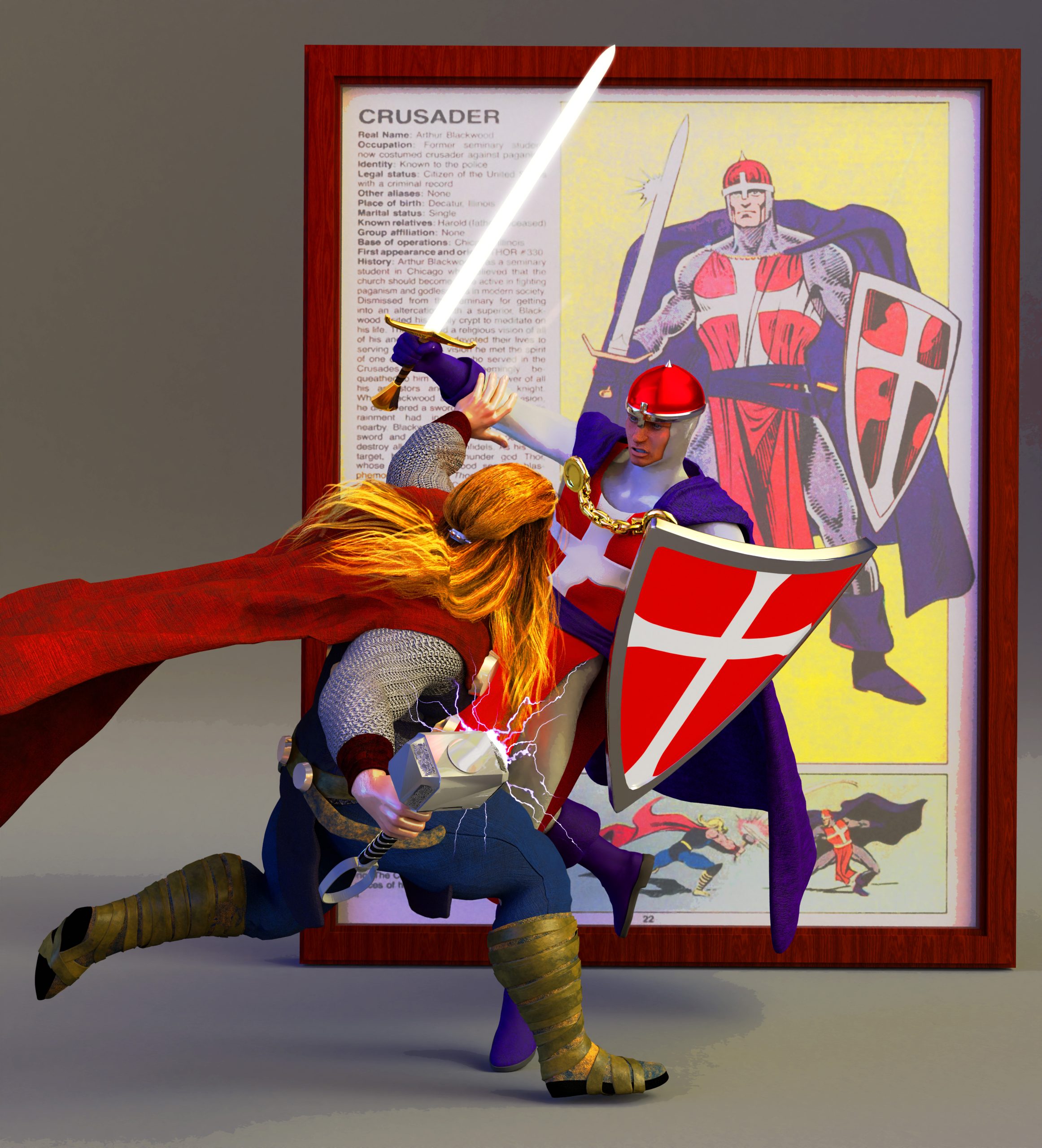
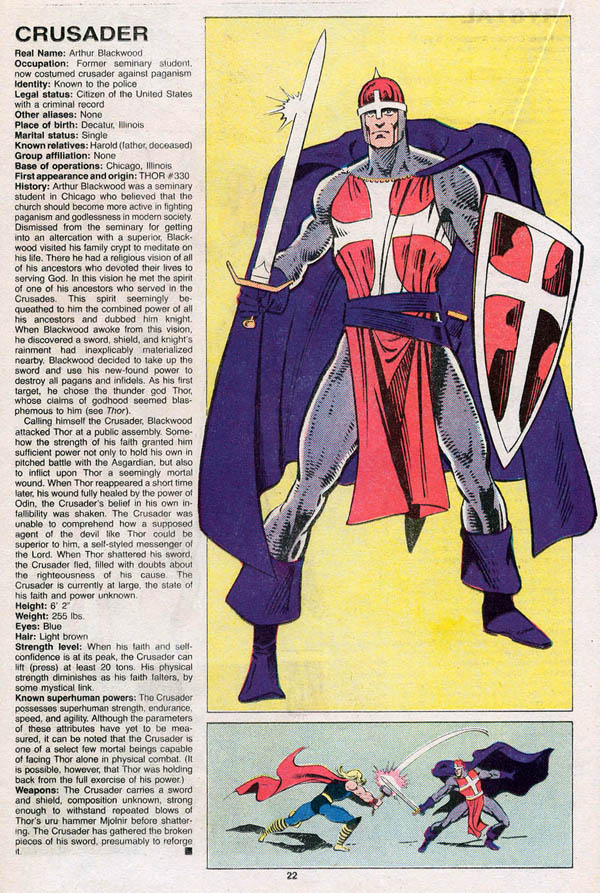
So when I first heard about the “christian” superhero from Marvel Comics, I was intrigued. No, this wasn’t the Illuminator. He came later. This was the Crusader. Bang howdy, but I was excited! Then I found his Marvel Universe Handbook entry.

Waitaminute! Heaven calls a guy to battle evil in the world, imbues him with supernatural armor and abilities, and the first person he goes after is Thor?! One of the good guys?! Because he’s a false god?!

Of course this was before Marvel leaned heavily into the Asgardians=Aliens theme. So, to all intents and purposes Thor was a god. And there were many of them in the Marvel Universe. DC, too. Yet I was sorely disappointed that this guy was just a tool to seemingly make Christians look foolish and inflexible in a world of gods and monsters, aliens, and ghost riders.

The irony was, as I grew older and learned a lot more about the actual Crusades, I began to see how much this character made sense. And in many ways it contributed to my own evolution, as I continued another lifelong pursuit, one of questioning and using my head. More on that for next time.

I have no idea where Crusader ended up over at the house that Stan built. I’d like to believe he found his faith again, maybe learned a valuable lesson about the greatest commandments, and went off to face Mephisto or Dr. Doom. Because, priorities, man!

I have my own version of a divine hero planned for my comic imprint, who already makes an indirect appearance in the Red Cat miniseries. Who you might ask? All will be revealed in time. Because over forty years later my faith, evolved as it is, still feels like a superpower to me. I can only hope my crusade is better aimed at bringing a little light of my own to the world. Ecclesia!